Gezelex · Research · 2026
The Object Is
Comprehension
How people build a working, predictive model of a complex operational environment — and what happens when that model is missing.
The Internal Picture
That Lets People Act
01
Object of Study
How people build a working, predictive model of a complex operational environment — the internal picture that lets them act correctly before any sign or instruction does.
02
Subject of Study
Whether building that model top-down — structure before procedure — outperforms the standard bottom-up chain (procedure → symbol → training) in multilingual, mixed-experience teams.
03
The Mechanism
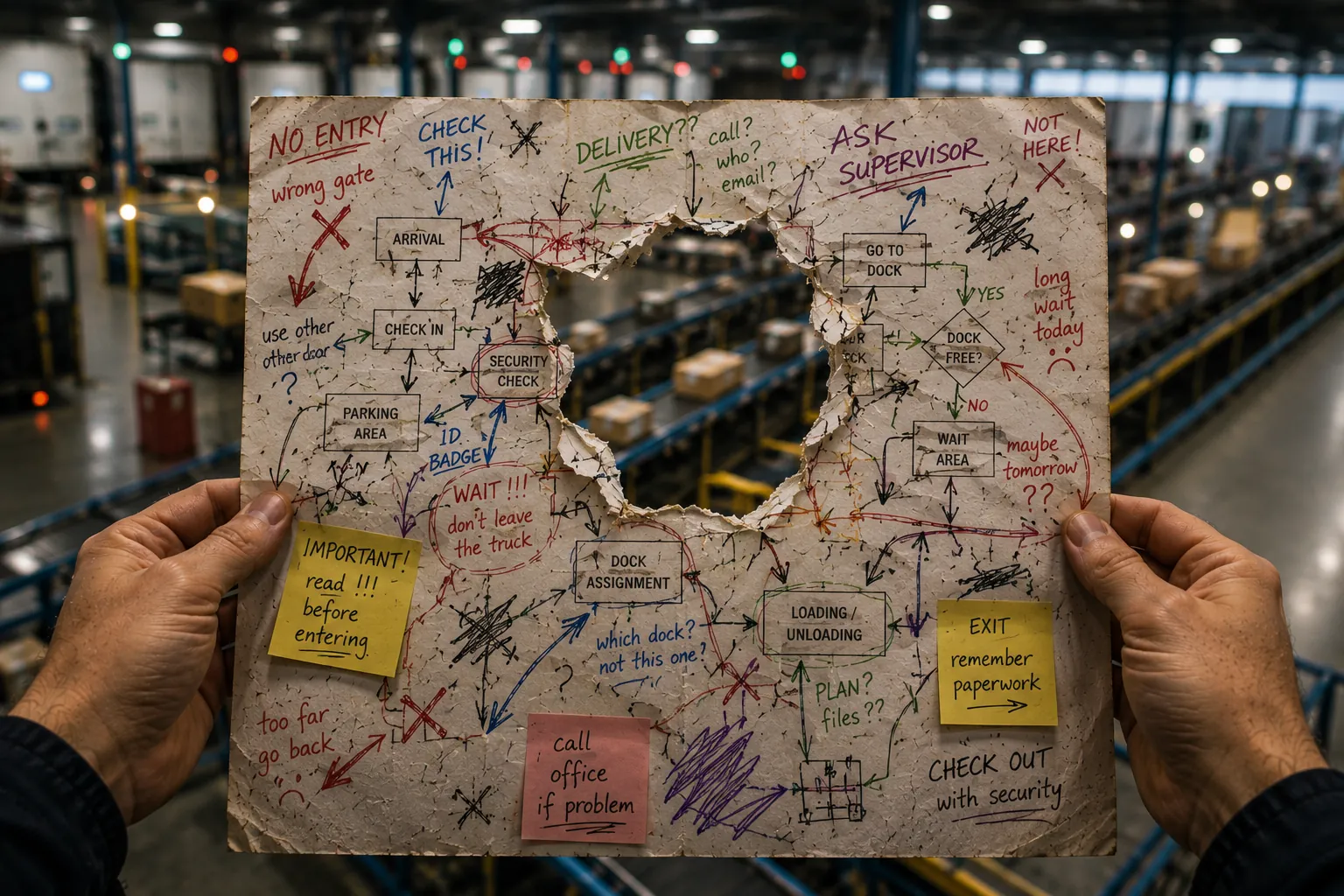
A predictive model isn't a map of what's in the room. It's a working guess, constantly updated, about what happens next — which is why a person with the right model reacts before a sign has to tell them anything.
The bottleneck left in these systems isn't computational — that part is largely solved. It's semantic: whether the environment is legible to the person standing inside it.
What We Test
These are hypotheses, not findings. What follows is what we test them against.
H1
A model built top-down produces faster comprehension than procedure-first training.
Procedure-first forces the person to infer structure from isolated fragments; structure-first gives them the fragment's place before they meet it.
H2
A correct predictive model reduces dependence on signage and infrastructure.
Signage compensates for a missing model; once the model exists, the compensation is no longer load-bearing.
H3
Errors drop at the point of decision, not after it.
Ambiguity resolved by a model is resolved before the action; ambiguity resolved by a sign is resolved only if the sign is seen in time.
Indicators
Where This Sits
Not Psychology, Not Ergonomics
This isn't a claim about individual differences or motivation, and it isn't a claim about visibility or reach distances. It sits where cognitive science meets the philosophy of meaning.
Why Now
Environments are getting more complex faster than people are being onboarded to understand them. Comprehension is still treated as compliance, patched after the fact by signage, not addressed as the cognitive problem it is. That gap is widening as automation and human judgment increasingly share the same floor.
This isn't specific to any one industry. How a mind builds a working model of a system it didn't design is the same question recurring everywhere that overlap grows.
Structure First,
Generation Last
The method runs in a fixed sequence. AI enters at the last step, applied to a structure already typed and constrained — not thrown at the problem first and hoped into shape.
| Conventional approach | Gezelex method | |
|---|---|---|
| Starting point | What to teach, decided by someone who rarely operates on the floor | Study the environment: name its entities, classify them, assign each type a graphic element |
| Structure | Procedure → symbol → training, assembled bottom-up from fragments | Structure before procedure — the fragment's place is established before it's encountered |
| AI role | First step: generate content, then check if it fits | Last step: generate from a model already typed and constrained |
| Feedback | Completion rates and click counts — measures itself, not the person | Heat maps from contextual delivery — what was accessed, where, and when |
The Object That
Explains Itself
Not a diagram of the method. The method, running — the same structure described above, rendered as something you can open and move through yourself.
See It WorkKeywords
An Open Invitation,
Not a Pitch
We're looking for operational environments willing to run an early pilot — not a finished product, a real test of the method against a real process.
What we are looking for
Operations with temporary, rotating, or external workforce
One defined zone or process available for 3–6 months
Willingness to track before and after
What a partner gets
No cost, no disruption to existing operations
A structured map of where operational knowledge breaks down
Visual instructions for the studied zone, ready after the research
Findings become public, published research — the goal isn't a proprietary tool
Where It Applies

Author
Yevhen Shapovalov
Independent researcher. Thirty years in design and systems thinking. This research grew from field experience — not from a lab.