
Gezelex · About
Yevhen Shapovalov
Visual communication · Research · Founder
For thirty years, I've worked in visual communication: making ideas understandable to the people who have to use them.
Not to simplify them — to make their complexity navigable. That distinction, it turns out, is everything.
Thirty years of visual communication
Architectural visualization and branding. Interfaces, interiors, small games. Environments not only on a screen, but in real life: park areas, public and commercial spaces, private homes. And a chapter of teaching along the way.
One problem, everywhere
In every one of those fields, I kept running into the same thing: people understand an author's intention differently from how it was meant.
And it's far wider than design. It starts with the most ordinary things — how to use a cup, a lock, a door handle — runs through children's toys, and ends in production lines and technical processes. Everywhere, there is a distance between what the author put in and what the people who meet it actually understand.
Seeing it, not yet solving it
For more than fifteen years, I've been developing my own model of how people coordinate around shared meaning — and why they so often don't. I applied it in industry, at a processing plant where complex operations had to be made clear to the people running them. In 2020, I published an article arguing that complex systems need deliberate methods of ordering, not more rules.
I could see the problem clearly. What I couldn't see yet was a way to solve it at scale.
A fresh start
Then circumstances beyond my control brought me to the Netherlands. No language, no local track record — but thirty years of expertise and a way of seeing systems that doesn't depend on any one country.
So I started from the ground: learning Dutch, going to interviews, talking to people across industries. Those conversations showed me where my knowledge was needed most — in fast-moving environments where people with different languages and different experience have to act as one.
Then the tools changed
AI changed what's possible. Problems I had been able to describe for years suddenly became solvable. In 2023, I conceived Gezelex as a project and began building it: writing, sketching, and modelling the method — how to build the picture people need before they have to act.
All my separate, very different experiences turned out to circle one question: the distance between intention and reality.
From the floor
With the project already underway, I started working on the operational floor of logistics. What I had described in theory, I now saw every day in practice.
The system works. But it works at a cost to the people inside it: the same confusion repeating, the same explanations given again and again, knowledge leaving with every person who moves on. Things run despite this, not because of it.
Why it matters now
For most of history, that gap between intention and understanding was an inconvenience. A misread handle, a confusing form. But as work and daily life become more automated and more technologically dense, the same gap becomes critical — and unsafe.
Closing it takes design, systems thinking, and real knowledge of the floor. I happen to bring all three — and I intend to put them to work.
"Once you can describe a problem precisely, you are obligated to do something about it."
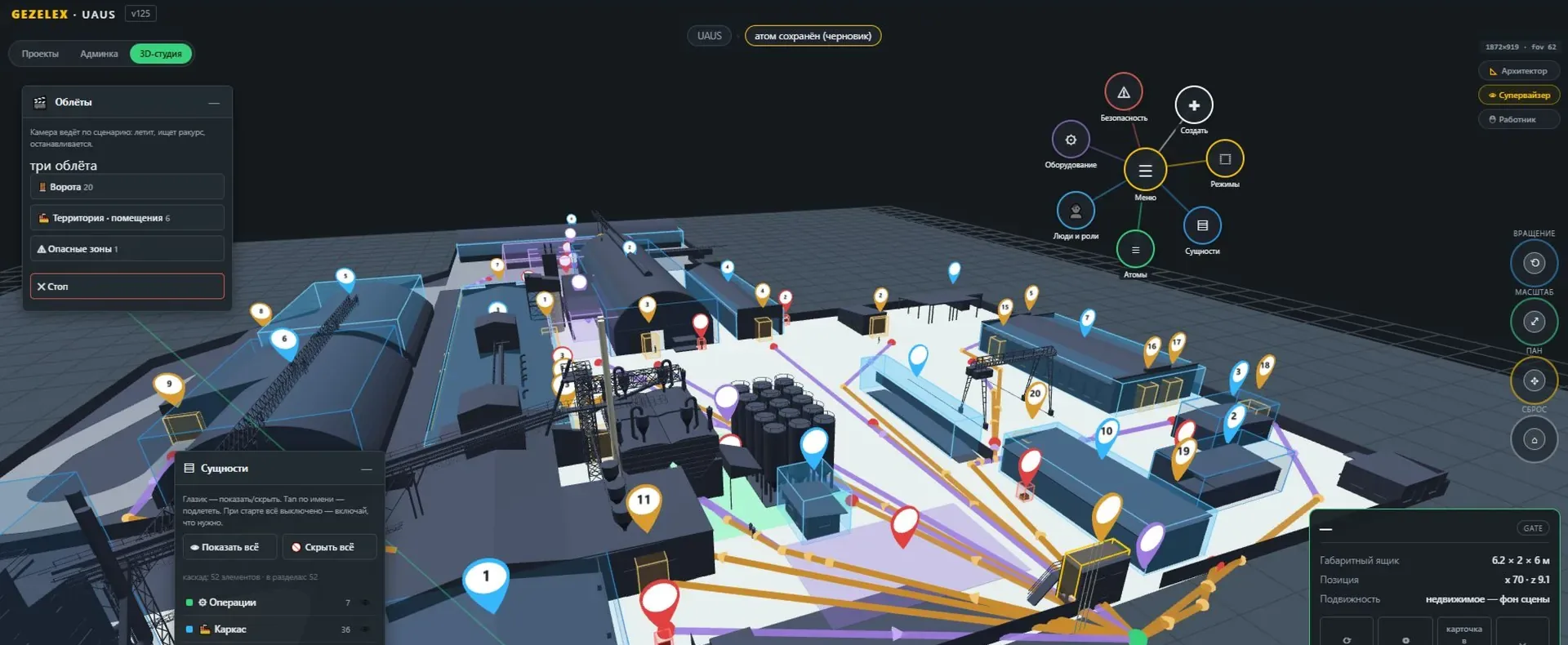
Gezelex · Cognitive digital twin — working prototype, 2026
What makes this possible
The eye for form
Three decades of design trained a particular kind of attention: how does a person actually read this? Not what does it say — what do they see, in what order, with what assumptions already loaded. That is not a skill. It is a habit of perception that changes how you see everything.
The systems instinct
Running companies across industries — design, technology, other sectors — required a different muscle: seeing how parts connect, and where they will break before they do. Strategy, operations, and human behavior are the same system viewed from different altitudes.
The field experience
The knowledge that matters most in this research doesn't come from literature reviews. It comes from standing in operational environments long enough to see what the procedures don't say. That takes time and a particular willingness to be wrong about what you thought you understood.
The compulsion to learn
Cognitive science. Semiotics. Behavioral economics. Game design. Organizational theory. The accumulation is not encyclopedic — it is structural. Every framework is a lens. The more lenses, the higher the resolution of the picture.
Gezelex is independent and self-funded. Not affiliated with any institution. The research is open — results, frameworks, and tools are published as they develop.
If you are building something in this space, working on a related question, or simply want to understand the framework better — the conversation is open.